

Quantum Advantage
Are quantum systems more powerful than classical ones? Random quantum circuit dynamics provide fertile territory for exploring information processing tasks that outperform any classical algorithm, even prior to fault tolerance.
The Bentsen Quantum Information Science group studies the dynamics of quantum information in quantum many-body systems.
The Bentsen Quantum Information Science group studies the dynamics of quantum information in quantum many-body systems. Our research aims to harness these quantum systems for applications in information processing, precision sensing, and simulation of many-body dynamics.
Our group aims to understand and exploit the physics of quantum many-body systems using tools from quantum information theory, condensed matter theory, the holographic principle, and cold-atom quantum simulators.
We pursue two interrelated goals: enhancing our understanding of naturally occurring phenomena in quantum many-body systems, and engineering new technologies and techniques inspired by these phenomena.
Are quantum systems more powerful than classical ones? Random quantum circuit dynamics provide fertile territory for exploring information processing tasks that outperform any classical algorithm, even prior to fault tolerance.

Quantum systems can be harnessed to make extremely precise measurements of external magnetic, electric, or gravitational fields for timekeeping, navigation, and security tasks.
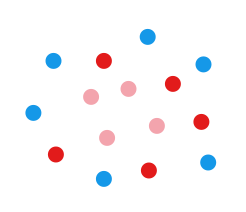
Strongly interacting quantum many-body systems remain poorly understood because they are computationally intractable to simulate on classical computers.

Quantum error-correcting codes and decoding algorithms enable real-time error detection and correction in near-term quantum computers.
The Bentsen QIS group leverages the dynamics of quantum information to inform controlled experiments in near-term quantum platforms employing neutral cold atoms, trapped ions, superconducting qubits, and other emerging quantum technologies.
Quantum information scrambling describes the spreading of local information across a quantum system in a complex pattern of entanglement. Understanding and harnessing this many-body entanglement provides new capabilities for sensing, simulation, and information processing.
Tractable models, controlled approximations, and solvable limits yield physical insight into challenging many-body physics problems.
High-performance computing tools enable testing of models and protocols across system size, noise, connectivity, and measurement constraints.
Control and measurement strategies are framed for realistic experimental platforms rather than idealized abstractions.
Open problems are tackled by collaborative dialogue with experimentalists, theorists, and industry collaborators.