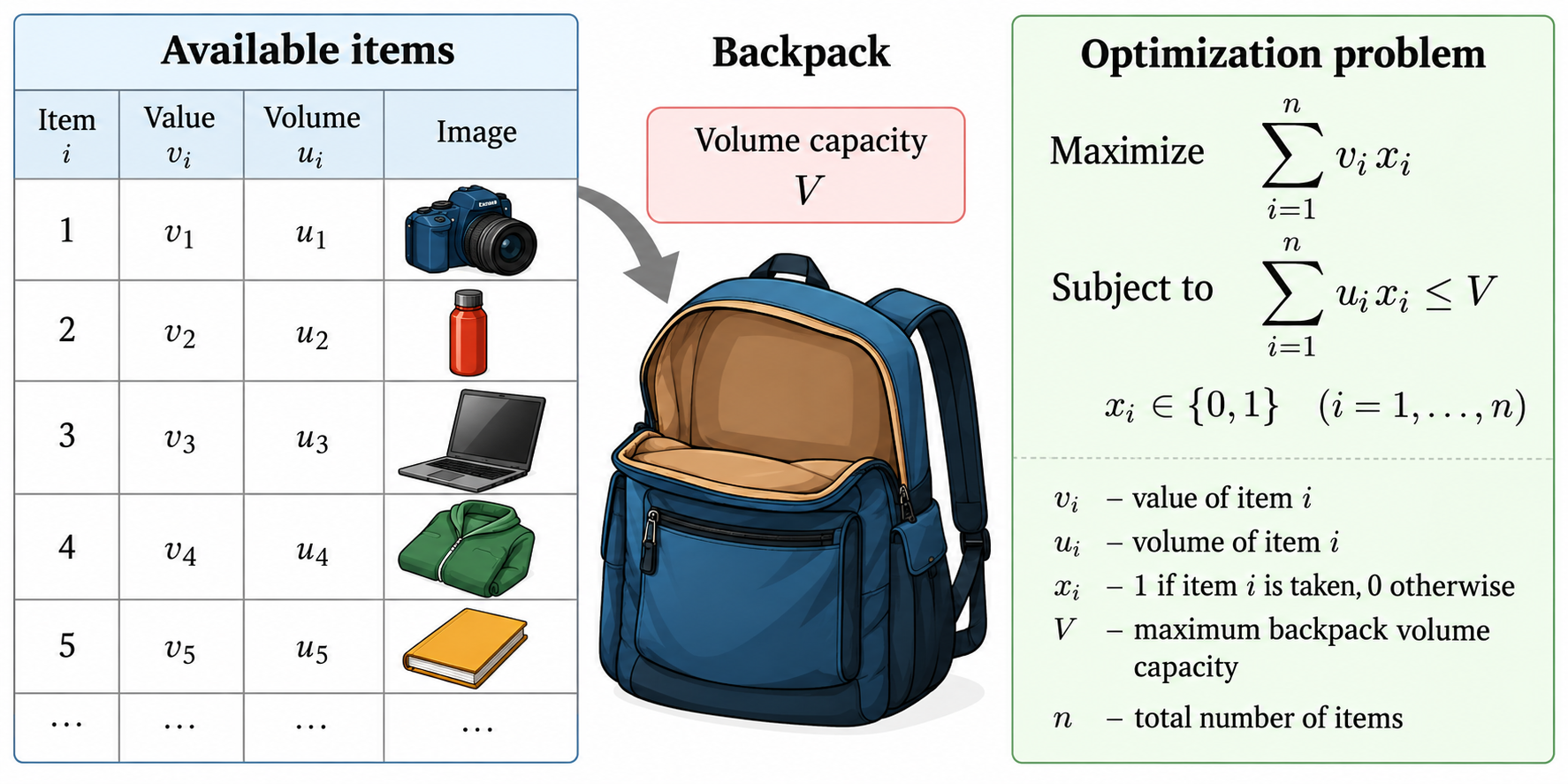
#!/usr/bin/env python3
import numpy as np

def backpack_binary(max_capacity, values, volumes):
    """ Solve backpack problem using binary coding approach."""
    n = len(values)
    max_value = 0
    best_combination = np.zeros(n, dtype=int)

# Try all possible combinations using binary representation

# From 0 to 2^n - 1 (all possible binary numbers with n bits)

for i in range(2**n):
        selected_items = np.zeros(n, dtype=int)

        code = bin(i)[2:].zfill(n) # string representing bits
        for i,s in enumerate(code):
            selected_items[i] = 1 if s=="1" else 0
        total_volume = np.sum(volumes * selected_items)
        total_value = np.sum(values * selected_items)

        if total_volume <= max_capacity:
            if total_value > max_value:
                max_value = total_value
                best_combination = selected_items.copy()
    return max_value, best_combination


def print_solution(values, volumes, max_capacity, max_value, selected_items):
    print(f"Backpack Capacity: {max_capacity}")
    print(f"Maximum Value: {max_value}")
    print(f"Selected Items: {selected_items}")
    print(f"{values=}")
    print(f"{volumes=}")
    print(f"Total number of objects: {len(values)}")


if __name__ == "__main__":
    print("====== Example 1 ===========")
    values1 = np.array([12, 10, 20, 15], dtype=int)
    volumes1 = np.array([2, 1, 3, 2], dtype=int)
    max_capacity1 = 5

    max_val1, selected1 = backpack_binary(max_capacity1, values1, volumes1)
    print_solution(values1, volumes1, max_capacity1, max_val1, selected1)

    print("====== Example 2 ===========")
    N=20
    values2 = (100*np.random.uniform(size=(N))).astype(int)
    volumes2 = (80*np.random.uniform(size=(N))).astype(int)
    max_capacity2 = 50

    import time
    t0 = time.time()
    max_val2, selected2 = backpack_binary(max_capacity2, values2, volumes2)
    print_solution(values2, volumes2, max_capacity2, max_val2, selected2)
    print(f"Execution time: {time.time() - t0}")