Problem 3:
-
Ocean tides are caused by the difference between the force the moon
exerts on the ocean on one side of the Earth and the ocean on the other side.
Calculate the difference between the force on 1 kg of water located on
the side of the Earth closest to the moon and that on 1 kg of water on
the side farthest from the moon. (Possibly) relevant data:
-
Earth-Moon distance REM = 3.84 x 10⁸ m
- Radius of the Earth = 6.37 x 10⁶ m
- Mass of the Earth ME = 5.98 x 1024 kg
- Mass of the Moon Mm = 7.26 x 10²² kg
- G = 6.67 x 10⁻¹¹ Nm2/kg2
Solution:
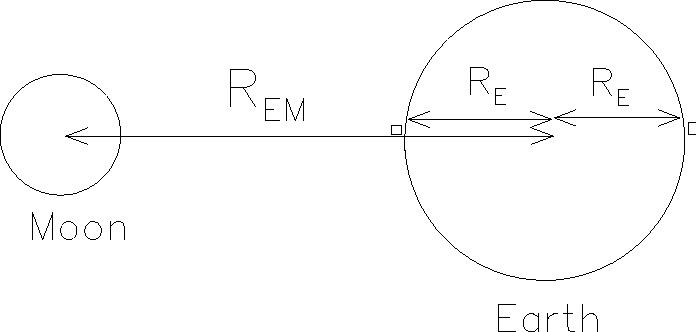
- This will just require applying Newton's law of universal gravitation twice,
to the two different bits of water. For the mass closest to the moon, we have
-
F = GmMm/(REM - RE)2
- since this kilogram of water is nearer the moon by the radius of the
Earth, and where m is the mass of the water, and Mm is the mass of the
moon, and where we are only calculating the magnitide of the force. Similarly, the
force on the other kilogram of water is
-
F = GmMm/(REM + RE)2
- The difference in the forces is then
-
 F = GmMm[
1/(REM - RE)2 - 1/(REM
+ RE)2]
F = GmMm[
1/(REM - RE)2 - 1/(REM
+ RE)2]
- Substituting in numbers gives
- = 2.18 x 10⁻⁶ N
- The force difference is tiny - nevertheless, it is sufficiently large to cause
the tides. The mass of the Earth was not needed in this problem - it was a
red herring...
Note: This is essentially the same as problem
12-42 from the suggested extra problems, and it
is also essentially identical to
the calculation of the
tidal forces on a barbell at the surface of a neutron star
(
problem 12-56 from the homework).
Next problem
Test 3 page
Physics 101 Home page
Physics Department Home Page
College of William and Mary,
Dept. of Physics
armd@physics.wm.edu
last updated: Nov. 19 1999