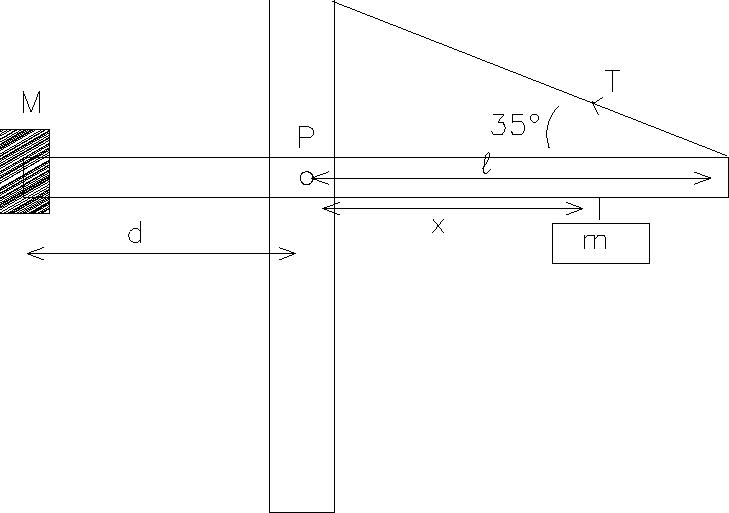
A crane consists of a tower and (massless) crossbeam, as shown. The crossbeam pivots about a hinge at point P. The counterweight M (103 kg) is located d = 10 m to the left of the hinge, and the load mass m is located x = 25 m to the right of the hinge. A cable is attached to the right end of the crossbeam, l = 30 m from the hinge at an angle of 35°. The maximum tension that the cable can withstand before breaking is 2 x 10⁴ N. What is the maximum mass m that can be supported?
Solution:
The forces on the crossbeam include the weights Mg and mg, the tension in the cable T , and the hinge force F. We don't know the direction of the hinge force, so we can consider it as two separate forces Fx and Fy in the horizontal and vertical directions respectively. We will choose the tension as the maximum value 2 x 10⁴ N, since we want to find the maximum m that can be lifted.
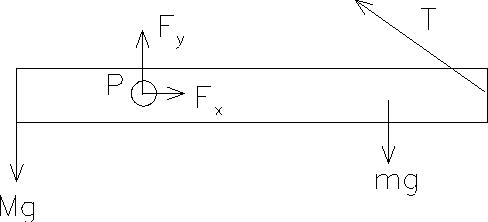
If we are crafty, and take the torque about point P, then the torque equation will not involve the hinge force (since it acts at point P). In this case the torque equation involves only one unknown, m, so we don't even need the force equations, and the algebra is trivial! We have
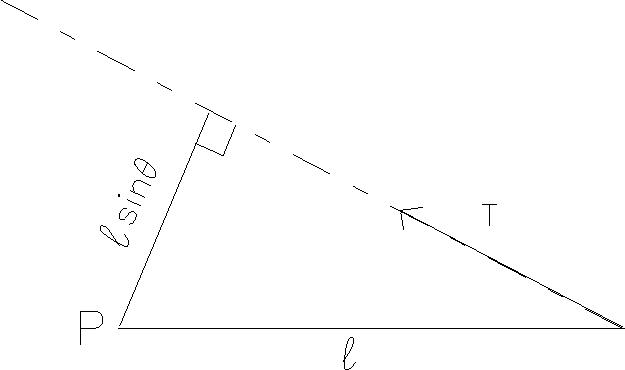
 = Mgd + Tsin
 l
-mgx = 0 l,
which can be obtained in three
equivalent ways:
l
-mgx = 0 l,
which can be obtained in three
equivalent ways:
 ,
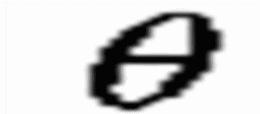
where is the angle between T and
l, which is 180° - 35°, but the sine of
180°- is the same as the sine of
.
,
where is the angle between T and
l, which is 180° - 35°, but the sine of
180°- is the same as the sine of
.  l]/gx
l]/gx Note:
This was an easier version of Problem 11-31 from the homework. A simple extension to the problem would be to ask for the hinge force, which would require use of the force equations.
Test 3 page
Physics 101 Home page
Physics Department Home Page